
September 2025
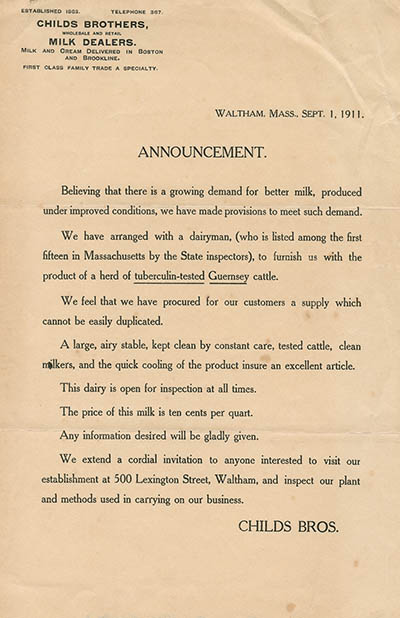
This broadside dated 1 September 1911 announces the acquisition of tuberculin-tested Guernsey cattle by Childs Brothers Milk Dealers of Waltham, Massachusetts, in response to health concerns about milk-borne diseases.
High infant mortality rates in the mid-19th century were linked to the transmission of disease through overcrowded living conditions, poor sanitation, and changes to the sourcing and processing of commercial milk. The dairy industry, which expanded quickly during industrialization without government oversight, took shortcuts that endangered the safety and health of both cattle and humans. In cities, dairy cattle were kept in cramped quarters and fed slop from local distilleries (these were called "swill dairies"). A lack of refrigeration and milk processing standards--along with the addition of substances such as plaster of Paris, charcoal, starch, sugar, flour, and eggs to make milk look whiter and creamier--made milk dangerous for people, particularly infants and children, to consume.
By the 1870s, cow’s milk was linked to diseases such as typhoid fever, scarlet fever, diphtheria, tonsillitis, and M. bovis, a form of tuberculosis found in cattle that spreads to humans through the consumption of contaminated, unpasteurized milk. It was not until 1895 that the dairy industry began to regularly pasteurize their milk to ensure it was safe for drinking. In 1911, Chicago and New York City mandated pasteurization, and by 1915, most American cities had pasteurized milk. Pasteurization, a process developed by Louis Pasteur in 1864 for the beer and wine industry, requires milk to be heated to between 161 and 275 degrees Fahrenheit, depending on the specific process and desired length of shelf life.
In Boston, two disease outbreaks in the early 20th century highlight the dangers of a contaminated milk supply. In April 1909, a milk distributor in Jamaica Plain died of typhoid fever. Authorities stated he contracted the disease as early as March 15th of that year, and during the time of his illness, continued his work as milk inspector, infecting the milk supply. By April 11th, 237 people in Jamaica Plain had contracted typhoid fever. In 1911, an outbreak of an unusual form of tonsilitis caused by staphylococci or streptococci from infected raw milk killed 48 and sickened 1,400 people in Boston. Medical inspectors were unable to pin down the exact bacteria that caused the outbreak but noted that the severity of the cases was similar to that of outbreaks in England, where they were referred to as "septic sore throat" and linked back to milk by health officials.
The Cambridge Medical Improvement Society's Milk Commission published guidelines in 1906 to help dairies create a better production environment for clean, safe milk. These guidelines mandated dairies to participate in frequent inspections and monthly certification procedures. There were also recommendations for cleanliness. Dairies were required to keep the barnyard free of manure and stagnant water; ensure stables were well-lit and ventilated; provide an adequate and accessible supply of clean water; instruct dairy workers to wash their hands with soap and water prior to working with cattle and stay home in cases of illness; disallow certain animals in the dairy, particularly pigs and goats; sterilize the milk, milk pails, bottling room, and utensils; cool the milk to 45 degrees Fahrenheit within an hour of milking; and clean the dairy wagons daily, noting that those wagons should only be used for the transportation of milk.
The Commission also had requirements for taking care of the cows in the herd. All herds had to pass a tuberculin test before they were milked. If a cow tested positive for tuberculosis, that cow would have to be immediately removed from the herd. Tuberculin tests had to be given to cattle every six months. In addition to the tuberculin testing, monthly veterinarian visits were recommended, and food with strong flavors, like garlic and brewers' grains, were not to be added to cows’ diets. Other suggestions, aimed at providing a safe and comfortable atmosphere for the cows, were also provided.
This broadside from Childs Brothers identifies the many concerns around the handling of milk in the early 20th century. Whether or not it was common practice for dairies at the time, their announcement may have eased the minds of the public at a time when milk-borne illness scares were all too common. The promotion of Childs Brothers' tuberculin tested cows and "...large, airy stable, kept clean by constant care, tested cattle, clean milkers, and the quick cooling of the product" demonstrates how changes in milk production were marketed to customers.
Unfortunately, not much remains in the historic record about Childs Brothers dairy. In early 1926, it was consolidated into the New England Creamery Products Company, with Alden Brothers Company of Boston, W.F. Noble and Sons Company of Somerville, and Cape Cod Creamery of Hyannis, with the business located in Somerville.
Cambridge Medical Improvement Society. Milk Commission. Circular of Information Concerning Certified Milk Cambridge, Mass., ca. 1906.
Centers for Disease Control. “About Bovine Tuberculosis in Humans,” 2024. Accessed August 27, 2025.
Currier, Russell W. and John A. Widness. “A Brief History of Milk Hygiene and Its Impact on Infant Mortality from 1875 to 1925 and Implications for Today: A Review,” in Journal of Food Protection, vol. 81, issue 10 (Oct. 1, 2018), p. 1713-1722.
"Finds Milk Strike Costly to Company,” in Boston Daily Globe, Nov. 6, 1926, p. 13.
Flynn, Dan. “Raw Milk Killed 48 in Boston Outbreak – 100 Years Ago,” in Food Safety News, March 16, 2012.
"Typhoid Traced.: Milkman, Himself Victim, Spread Disease. J. J. Fallon Worked a Fortnight Without Suspecting Illness, in Boston Daily Globe, Apr 11, 1908, p. 2.
Winslow, C.-E. A. “An Outbreak of Tonsilitis or Septic Sore Throat in Eastern Massachusetts and Its Relation to an Infected Milk Supply,” in The Journal of Infectious Diseases, vol. 10, no. 1 (Jan. 1912), p. 73-112
Worcester West Milk Producers’ Association. How Pure Milk May Be Supplied to Boston at Reasonable Prices to Consumer and Fair Returns to Producer: A Plan … Boston: Press of George H. Ellis, 1880