
July 2025
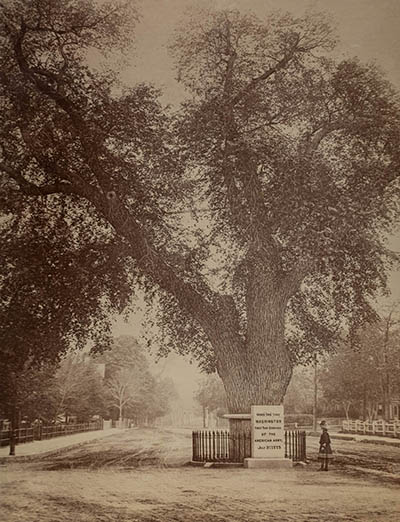
This photograph, probably taken by D. W. Butterfield before 1919, shows an unidentified girl viewing the so-called Washington Elm, which formerly stood in the middle of Garden Street in Cambridge.
July 2nd marks the 250th anniversary of George Washington's arrival in Cambridge to assume command of the American forces at Cambridge or, as Washington described it in a letter to his brother, "a numerous army of Provencials under very little command, discipline, or order." Arriving in a steady rainfall, Washington and Charles Lee "road out to the line of forts at Prospect Hill," but could not see the British forces well. When the weather cleared on the third of July, Washington and Lee inspected troops in Cambridge and surrounding towns. Cantabrigian lore long held, however, that Washington stood under the great elm tree that day, ceremonially raising his sword and taking command of the troops among throngs of onlookers—something Washington himself (and many other primary sources) never mention. In 1864, in the throes of the civil War, the city erected the plaque shown in the photograph to commemorate this patriotic "fact."
The main source for the legend seems to be the diary of a Revolutionary woman named Dorothy Dudley, which was published in 1876 by the Ladies Centennial Committee of Cambridge as Theatrum Majorum. The Cambridge of 1776. In it, Dorothy writes of the occasion
To-day he formally took command, under one of the grand old elms on the common. It was a magnificent sight. The majestic figure of the General, mounted upon his horse beneath the wide-spreading branches of the patriarch tree; the multitude thronging the plain around, and the houses filled with interested spectators of the scene, while the air rung with shouts of enthusiastic welcome, as he drew his sword, and thus declared himself Commander-in-chief of the Continental Army.
A heroic image for the ages, repeated in numerous schoolbooks and histories over the years and memorialized in a stirring Currier & Ives print (also published in 1876). Dorothy's diary was taken at face value by many people and even republished as a primary source as late as the 1970s. It was, however, a fantasy--an admitted one—as, in a preface to a second 1876 edition, the editor "embraces the opportunity to confess that the Diary of Dorothy Dudley was written expressly for The Cambridge of 1776 by Miss [Mary Williams] Greely."
"Dorothy" was not the only one propagating the legend of the Washington elm. In 1905, Watson Grant Cutter, the Vice-President of the Cambridge Chapter of the Sons of the American Revolution, gave an impassioned address defending the legend. And how did he know it was true? His family—Cambridge residents from the earliest days—said it was. When passing the elm, his parents would always say, "Children, this is the Washington Elm; under it Washington took command of the army in 1775. Always remember it. We were told so by our parents and they were told so by their fathers, who were here at the time. This is historic ground."
It is this kind of "proof" that Samuel F. Batchelder took solid aim at in a letter to the editor written for the Cambridge Tribune after he had been so bold as to question the tradition of the Washington elm after the tree's demise in 1923. His letter attempted to apply common sense and evidence to the case; stipulating that while Washington may have been associated with the tree in a "simple and natural way," the tree "should emphatically not be associated with him in the traditional way." It is unknown how many (if any) minds were swayed by his letter.
In his letter, Batchelder also mentioned the sheer number of famous trees in Cambridge—the "Whitfield elm," the "Oak of Council," the "Spreading Chestnut Tree" of the village smithy, the Rebellion and Class trees in Harvard Yard, and the "Palisade Willows" on Mount Auburn. Was it simply that Washington too, "needed" a tree to commemorate his presence in Cambridge in 1775 and this elm was otherwise unassigned? Since all legend comes from some shred of truth, Batchelder concluded that Washington did "something" under the tree, but not what had come down through history.
In 1931, the Arnold Arboretum weighed in on the legend of the Washington elm, replying to multiple inquiries as to Washington elm "descendant" trees then being sold by nurserymen. The tree itself, for a long time in a state of decay, had succumbed to old age, disease, and modern life in 1923 and the staff of the Arboretum cast doubts on both the legend ("no absolute proof that Washington either "assumed command" ... or that he noticed it [the tree] or cared for it") and the nurserymen's claims of the "authenticity of the origin" of their trees. They further cast doubt on the legend by noting that in 1775, the tree would have been only 56-62 years old and less than 8 feet around, hardly the patriarch or "hoary wide branched monarch of its kind" of legend.
David W. Butterfield (1844-1933) was a prominent Boston photographer who used a mammoth camera to record historic events such as the Great Boston Fire of 1872 and was also known for his photographs of United States presidents.
Batchelder, Samuel F. The Washington Elm Tradition “Under This Tree Washington First Took Command of the American Army” Is it True?: The Evidence Collected and Considered Cambridge: Reprinted from the Cambridge Tribune, 1925
Cutter, Watson G. Family Traditions Concerning the Washington Elm [Cambridge, 1907?]
Gilman, Arthur, ed. Theatrum Majorum: the Cambridge of 1776, 2nd ed. Cambridge: [Ladies Centennial Committee], 1876
Jack, J. G. “The Cambridge Washington Elm,” Arnold Arboretum Harvard University Bulletin of Popular Information, series 3, vol. 5 (Dec. 10, 1931)
Norton, Mary Beth. “Hetty Shepard, Dorothy Dudley, and Other Fictional Colonial Women I Have Come to Know Altogether Too Well,” Journal of Women’s History, vol. 10, no. 3 (Autumn 1998), p. 141-154
----. “Letter to the Editor,” William & Mary Quarterly, 3rd series, vol. 33, no. 4 (Oct. 1976), p. 715-717
Washington, George. Papers of George Washington: Revolutionary War Series, vol. 1 Charlottesville: University Press of Virginia, 1985.