
February 2026
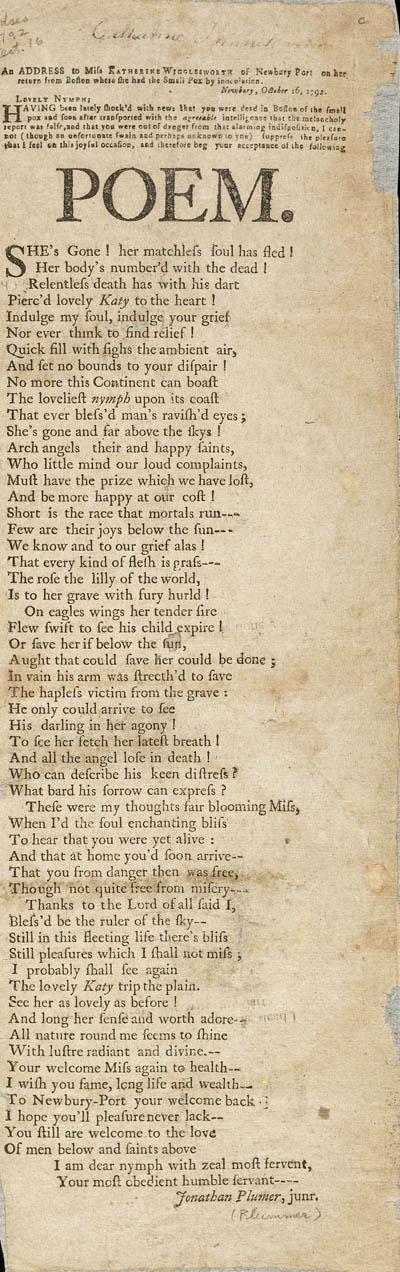
This broadside, published in 1792, expresses the jubilation of itinerant poet and peddler Jonathan Plummer upon finding that Miss Katherine Wigglesworth had not died of smallpox, but been inoculated and survived.
Jonathan Plummer (or Plumer) was born in Newburyport, Massachusetts, in 1761, one of nine children born to cordwainer Jonathan Plummer and his wife Abigail (Greenleaf). According to Roger Higgins’s biography, he was a sickly child with a “reputation for being a strange and wayward boy with a flair for revival meetings.” Although his brothers attended school, Jonathan’s education comprised Biblical training from his mother and a prodigious love of reading. As he matured, he tried on a number of professions, from preacher to soldier, leather worker to privateer. It would be the “peddling business” that became Plummer’s life work, being “a roving peddler, trading and chatting with the ladies here and there, being kissed and hugged by some females, and disdained on account of the lowness of my business by others” his destiny.
In addition to peddling a variety of wares, Plummer wrote and published poems and ballads, including our featured Address to Miss Katherine Wigglesworth of Newbury Port. At the end of the 18th century, smallpox was still a deadly scourge, although people were able to be inoculated by the technique of variolation—inserting a small amount of viral matter (pus) into people to spur their immune response. Survival was by no means a sure thing but Katherine seems to have done just fine and Plummer “though an unfortunate swain and perhaps unknown to you,” not to mention almost 20 years older, felt the need to express his joy at her survival through a poem. Calling her “the loveliest nymph upon its coast / that ever bless’d man’s ravish’d eyes,” Plummer employs over the top emotional language to express his grief and then joy at her survival. One can only wonder what Katherine’s family, friends, and neighbors thought—not to mention Katherine herself—who may in fact not have known Plummer personally and little imagined his fevered devotion to her.
This was not Plummer’s first attempt at courtship by ode. He had previously written nine stanzas “To Florella of Deerfield,” who, according to Plummer’s own account, “received it with an air of superlative disdain.” In 1793, a year after the Wigglesworth ode, Plummer published a broadside entitled Plumer’s Declaration of War with the Fair Ladies of the Five Northern States, blaming them for “wounding my heart with a most prodigious number of shots and darts, you have absolutely made it your prisoner.” Sadly for Plummer, none of his poetic exhortations hit its mark and he would remain unmarried until his death despite his willingness “to have the first wealthy old maid or widow I could coax to give me her hand, without paying the least attention in the case to abilities, character, or beauty.” Plummer continued his balladeering and odd jobs until his death in 1819. His will included a stipulation that money be used to publish 600 copies of his memoir to be given away (no more than one to a family) within four years of his decease. His will was judged invalid as it was agreed he was not of sound mind and his estate went to his siblings and other family members.
Katherine (also spelled Catherine or Catharine) Wigglesworth was born in 1780 to Edward Wigglesworth and his wife Bridget (Cogswell). Edward was a graduate of Harvard and a Colonel during the Revolutionary War, serving under Horatio Gates. He was active in Newburyport politics serving as school committeeman, fire warden, and selectman as well as a member of the Massachusetts House. The family’s prominence in town no doubt brought Katherine to Plummer’s notice. Having survived the embarrassment and consternation that his tribute must have caused her 12-year-old self, Katherine went on with her life and in 1805 married Samuel Dole of Newburyport, with whom she had 8 children. Samuel died in 1827 at the age of 50; Catherine lived in Newburyport as a widow until after 1865 when she is listed, aged 84, in the Massachusetts census living with her son Samuel and his family.
Higgins, Roger Wolcott and Jonathan Plummer, Jr. “The Memoirs of Jonathan Plummer, Jr., 1761-1819,” in The New England Quarterly, vol. 8, no. 1 (March 1935), p. 84-98.
Housman, Talya. Variolation vs. Vaccination: 18th Century Developments in Smallpox Inoculation | Beehive.
Plummer, Jonathan. Sketch of the History of the Life and Adventures of Jonathan Plummer, Jun. [Newburyport: Blunt & March, 1795]
Vail, R. W. G. “Writings of Jonathan Plummer,” in Proceedings of the American Antiquarian Society, Oct. 1933, p. 248-253.